Why 90% of Traders Fail (And How to Stop Donating Your Money to the Market)
4/20/2026
Why 90% of Traders Fail (And How to Stop Donating Your Money to the Market)
Let’s be brutally honest for a second. If you spend enough time scrolling through social media, you’d think trading is the easiest gig in the world. You see the screenshots of massive green percentages, the luxury cars, and the "laptop lifestyle" posts from a beach in Bali. But behind the scenes, the reality is a lot darker. The industry standard metric—the one nobody likes to talk about—is that roughly 90% of retail traders lose their money, quit, and never come back. They don't just lose a little bit; they blow up their entire accounts. So, what is actually happening? Why do so many smart, capable people step into the markets and get absolutely crushed? It usually comes down to a few critical, repetitive mistakes. If you can understand these traps before you fall into them, you’re already ahead of the majority.
1. The Leverage Illusion and the Math of Ruin
The single biggest account killer isn't a bad strategy; it’s a complete misunderstanding of leverage and risk math. When new traders discover futures, they see 20x, 50x, or 100x leverage and think it’s a cheat code for early retirement. They treat it like free money. But leverage is a double-edged sword that cuts much deeper on the downside. What most people fail to realize is that the mechanics of liquidation aren't a unified standard across the crypto space. A position that survives a sudden market drop on Binance might actually get liquidated on Bitget or MEXC during the exact same violent wick. This happens because every exchange calculates index prices, mark prices, and maintenance margins slightly differently. If you aren't running the exact numbers on your liquidation points before you enter a trade, you aren't trading—you are just gambling. You have to know your exact risk exposure, and simply guessing your margin requirements is the fastest way to zero.
2. The Revenge Trading Spiral
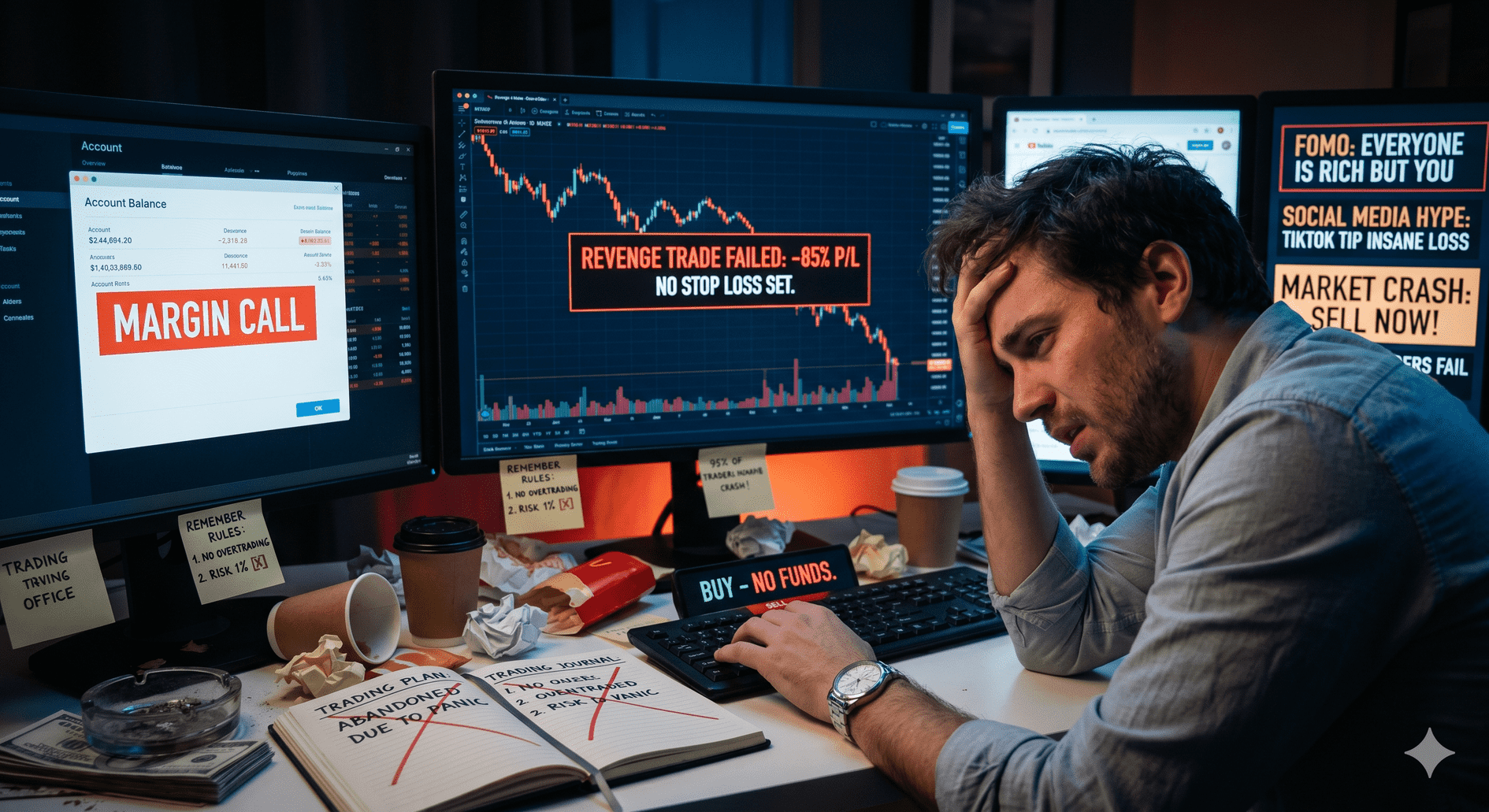
We have all been there. You take a setup that looks perfect. You’ve done your analysis, the chart aligns, and you enter the trade. Then, out of nowhere, the market turns against you and hits your stop loss. A professional trader accepts this. They know that even the best strategies only have a 60% or 70% win rate, which means losing is literally part of the job. But a struggling trader takes the loss personally. The ego kicks in. You feel the sudden urge to "make it back" immediately. This is revenge trading. You immediately re-enter the market, often with a larger position size to recover the lost money, completely ignoring your trading plan. You are no longer trading the chart; you are trading your emotions. This is usually the exact moment an account gets wiped out. The market doesn't know you, it doesn't care about your feelings, and it will happily take your money if you trade out of anger.
3. Trading the PnL Instead of the Chart
If you are constantly staring at your floating Profit and Loss (PnL) while in a trade, you are setting yourself up for failure. When you watch the dollar amount fluctuate, fear and greed take over. If the trade goes slightly in your favor, you get anxious that the market will reverse, so you close it out early for a tiny win. But when the trade goes against you, hope takes over. You hold onto the losing position, hoping it will turn around, eventually letting a small, manageable loss turn into a catastrophic one. This creates a toxic mathematical cycle: you cut your winners short and let your losers run. To survive, you have to trade the structure of the chart. If your target hasn't been hit, and your invalidation point (stop loss) hasn't been breached, you have to sit on your hands and let the trade play out.
4. Strategy Hopping and the Missing Edge
Another classic trap is the endless search for the "holy grail" indicator. A beginner will learn a strategy—let's say moving average crossovers. They try it for two days, take three losses in a row, and immediately decide the strategy is garbage. They jump on YouTube, find a new strategy about order blocks, try it for a week, lose again, and move on to the next one. They never stick with one system long enough to actually build an edge. Every strategy has periods of drawdown. The market cycles between trending and ranging, and no single strategy works perfectly in every condition. Successful traders don't have a magic indicator; they just have a system they have backtested relentlessly. They know the exact probability of their setup playing out, which gives them the confidence to execute the trade even after a string of losses.
5. Ignoring Position Sizing
You can have a terrible win rate and still make money if your risk management is dialed in. Conversely, you can have a great win rate and blow your account if your position sizing is chaotic. Let's say you risk 50% of your account on a single "sure thing" trade. You only need to be wrong twice to lose everything. Professional traders rarely risk more than 1% to 2% of their total account capital on a single setup. By keeping position sizes strictly controlled, a string of five or even ten consecutive losses becomes a minor bump in the road rather than an account-ending disaster. The Bottom Line Trading is not a get-rich-quick scheme; it is a highly competitive performance arena. You are going up against algorithms, institutional funds, and millions of other people trying to take your money. To survive, you need to shift your mindset. Stop focusing on how much money you can make today, and start focusing on how much money you can protect. Build your tools, understand your leverage limits across different platforms, manage your risk like a professional, and leave your ego at the door. The market pays the disciplined and takes from the impatient. Decide which one you want to be.